
Introduction: Growth Is Good—Until Hosting Breaks
Every website owner dreams of growth. More visitors, higher engagement, and better conversions sound great—until your website starts loading slowly, crashing, or showing errors. That’s when reality hits. Your hosting couldn’t keep up.
This is where a scalable hosting solution becomes critical. Growth without scalability is like driving a sports car on a narrow village road—it just won’t work. In this guide, you’ll learn why hosting failures happen, how scalability solves them, and how to future-proof your website.
What Is Web Hosting?
Web hosting is a service that allows your website to be accessible on the internet. Hosting providers store your website’s files—images, code, databases—on servers connected to the web.
Without hosting, your website simply cannot exist online. Think of hosting as the land where your house (website) is built.
Web Hosting Examples
| Provider | Hosting Type | Best For |
| Hostinger | Shared, Cloud, VPS | Beginners & growing sites |
| Bluehost | Shared, VPS | WordPress blogs |
| SiteGround | Cloud | High-performance sites |
For a deeper technical explanation, see Wikipedia’s Web Hosting overview:
What Is Web Hosting vs Domain?
Many beginners confuse hosting with domains.
| Feature | Web Hosting | Domain |
| Purpose | Stores website files | Website address |
| Example | Server space | example.com |
| Required | Yes | Yes |
Your domain points visitors to your hosting server. Without hosting, a domain is just a name with no content.
What Is Web Hosting and How Does It Work?
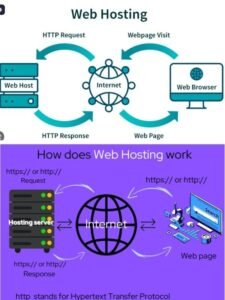
When someone types your domain into a browser:
- The browser finds your hosting server.
- The server processes the request.
- Website files are sent to the visitor.
- The page loads on their screen.
If traffic spikes and your server lacks resources, the process slows or fails. That’s exactly why scalable hosting solutions matter.
What Is a Hosting Platform?
A hosting platform is the environment that manages:
- Server resources
- Security
- Software
- Performance optimization
Modern hosting platforms use dashboards, automation, and cloud infrastructure to adjust resources dynamically. Platforms like cloud hosting systems are built with scalability in mind from day one.
Types of Web Hosting
Choosing the wrong hosting type is the fastest way to kill growth.
Shared Hosting
- Low cost
- Limited resources
- Poor scalability
Best for small blogs only.
VPS Hosting
- Dedicated virtual resources
- Moderate scalability
- More control
Cloud Hosting
- Auto-scaling resources
- High uptime
- Excellent for growing websites
This is the heart of a scalable hosting solution.
Dedicated Hosting
- Full physical server
- Very expensive
- Overkill for most sites
Is Web Hosting Necessary for a Website?
Yes—100%.
Even website builders like WordPress, Shopify, or Wix rely on hosting infrastructure. Without hosting:
- No storage
- No performance
- No visitors
A scalable hosting solution ensures your website doesn’t collapse when success arrives.
Scalable Hosting Solution: What Does it Mean?
Scalable hosting means your hosting environment can:
- Handle traffic spikes
- Add resources automatically
- Maintain performance during growth
Instead of migrating every time you grow, scalable hosting grows with you. Cloud hosting is the most common example of scalable hosting today.
How to Solve Scalability Issues
Here’s how professionals fix hosting scalability problems:
- Move from shared to cloud hosting
- Use load balancing
- Optimize databases
- Implement caching
- Choose hosting providers that support auto-scaling
Ignoring these steps leads to downtime, lost revenue, and SEO penalties.
How to Make Your Website Scalable
A truly scalable website isn’t built by accident. It’s the result of smart hosting choices combined with thoughtful development practices. Scalability ensures your website continues to perform well as traffic, content, and user activity increase—without crashes, slowdowns, or costly emergency fixes.
Let’s break this down in a clear, practical way.
1. Choose a Scalable Hosting Solution
Everything starts with hosting. If your hosting can’t grow, your website can’t either. Scalable hosting solutions—such as cloud hosting or managed VPS—allow you to increase resources like CPU, RAM, and storage as demand rises.
Instead of migrating to a new server every time your site grows, scalable hosting adjusts in real time. This means smoother growth, fewer interruptions, and better long-term stability.
Get best Hosting Services here
2. Optimize Images and Scripts
Large images and unoptimized scripts are silent performance killers. As your site grows, these issues multiply.
To improve scalability:
- Compress images without losing quality
- Use modern formats like WebP
- Minify CSS, JavaScript, and HTML files
- Remove unused plugins and scripts
Optimized assets reduce server load, making it easier for your website to handle more visitors at the same time.
3. Use CDN Services
A Content Delivery Network (CDN) stores copies of your website’s static files on servers around the world. When a visitor accesses your site, content is delivered from the nearest server.
This results in:
- Faster load times globally
- Reduced pressure on your main server
- Better performance during traffic surges
CDNs are one of the simplest and most effective tools for improving website scalability.
4. Monitor Performance Regularly
Scalability isn’t something you set and forget. Regular monitoring helps you spot issues before they become serious problems.
Track:
- Page load speed
- Server response time
- Traffic spikes
- Error rates
Using performance monitoring tools allows you to scale proactively instead of reacting to failures after they happen.
5. Plan for Traffic Growth
Many websites fail because they plan for today, not tomorrow. Scalability requires foresight.
Ask yourself:
- What happens if traffic doubles?
- Can my hosting handle a viral post?
- Will my database perform under heavy load?
By planning ahead and choosing flexible systems, you ensure your website grows smoothly rather than collapsing under success.
Remember: Scalability isn’t a one-time fix—it’s an ongoing strategy that evolves with your website.
What Does It Mean When a Solution Is Scalable?
A solution is considered scalable when it can handle increased demand without breaking or losing performance. In the context of websites and hosting, scalability means your infrastructure can adapt as your audience grows.
In practical terms, a scalable solution delivers:
- No downtime during traffic spikes
Your site stays online even during high-demand events. - Stable load times
Pages load consistently fast, regardless of how many users are visiting. - Flexible resource allocation
Server resources can increase or decrease based on real-time needs.
When your hosting and website architecture are scalable, growth becomes sustainable instead of risky.
Scalability equals sustainability. It protects your website’s performance, reputation, and revenue as success accelerates—ensuring your digital foundation is strong enough to support long-term growth.
Frequently Asked Questions (FAQs)
1. What is the best scalable hosting solution for beginners?
Cloud hosting is ideal due to auto-scaling and affordability.
2. Can shared hosting scale?
Not effectively. Shared hosting has strict resource limits.
3. Is scalable hosting expensive?
No. Many cloud plans start cheap and grow gradually.
4. Does scalable hosting improve SEO?
Yes. Faster load times and uptime directly impact rankings.
5. When should I upgrade to scalable hosting?
When traffic grows, pages slow down, or errors appear.
6. Is VPS hosting scalable?
Yes, but manual scaling is often required.
Conclusion
Website growth should feel exciting—not stressful. When your hosting fails, it’s not your success that’s the problem. It’s your infrastructure.
A scalable hosting solution ensures your website remains fast, secure, and reliable—no matter how big it grows. Invest early, scale smartly, and let your success flourish without limits.
Pingback: Hostinger Web Hosting Review 2026 – Comparison With Top Competitors - Webhosting